Couchsurfing Host in the Democratic Republic of Congo

Couchsurfing Host in the Democratic Republic of Congo

Local Lingo with...

the Democratic Republic of Congo

My favorite part about backpacking is meeting new people and learning their stories.  “Local Lingo” is a part of my site that interviews individuals from all over the world who have made an impact on me. Not everyone gets the chance to interact with locals while they travel, but it’s beneficial and intriguing to understand different perspectives from around the world. 

The Local

John Paul Zihalirwa

John Paul Zihalirwa

Local Tour Operator

Nationality: Congolese

Hometown: Goma, the Democratic Republic of Congo

Age: 33

Job Description: Welcomes and shows around tourists

Description of DRC in one-sentence: “Congo is the paradise on earth.”

How did we meet?

I interviewed John-Paul, who I met via Couchsurfing in The Democratic Republic of Congo. After the first 5 minutes of having a conversation with John-Paul, I could tell he was a quality person. His spirit was warm, his helpfulness was genuine, and he made sure to take care of me while I was in his country. Not only did he organize accommodation and transport to the Congo Gorilla Trek and Volcano hike, but also – more importantly – he taught me about the current state of The Congo. He is the first person I am featuring in “Local Lingo.”

The Interview

Background Questions 

Q. How would describe your childhood?

A. I spent all my childhood in Goma. It was a long story to grow up, particularly all the devil things which I have seen and for this, I can give thanks to God only.

Q. What’s your favorite food to eat?

A. Well, all the food from Congo is my favorite, because it is delicious, makes you strong and gives enough energy.

Q. What causes stress in your life?

A. When I look at something and don’t get it – this creates stress in me. I really hate to be stressed, so I do whatever I can to avoid being stressed. for something which it can create for me the deeply death cause of the stress.

Q. What do you do for fun?

A. Sports, seeing & discovering new things, going out with friends, and watching TV

Q. What makes you happy?

A. If a person doesn’t have any problems, this is what makes me happy.

Q. Did you go to college? What did you study? Afterward, was it easy to find a job?

A.Yes, I went to Mwanga and studied administrative commercial. It was not easy to get a job after my studies. It took me years to get my first job before starting tourism.  I lost hope because everyone was refusing to give me opportunities. My life was not easy, filled with tribulations. When living in a place like this, you need to be prepared for all the pure bad things that can happen to you.

Homecountry Questions 

Q. The Congo is known for it’s instability, corruption, and violence? How would you describe the Congo? Have you ever felt unsafe living in Goma?

A. Yeah for this, sure – I agree. Of course, Congo is known for its bad reputation because of the bad things that happened in the past years. Instability, corruption, and all kinds of violence – this is true. Even if I feel unsafe, where can I go? There is not a better place to live than Goma, because today Goma is a good place. We are here because there are international, national, and provincial authorities.

Q. Why should people visit the Congo?

A. All is here in the province of North Kivu, Goma. You might hear bad things about it, but go and see for yourself. Once you are here, you will want to come again because you will love it. There are good people and beautiful things to discover. For tourists – first, you have to know what you can do or what you are going to see. There are two national parks in eastern DRC. The one in Goma, Virunga National Park, is where you can look at all kinds of animals like gorillas, chimpanzees, and other monkeys. There’s also the Mount Nyiragongo, which is an active volcano in Goma. You won’t find a volcano like this in the whole of Africa or anywhere else in the world. There’s another volcano, called Nyamuragira, which neighbors Nyiragongo. In Goma, there are also kayaks that you can take on Lake Kivu, one of the largest lakes in Africa. Another thing you can do is visit the Pygmies and different villages.

Q. : How has the closing of Virunga National Park affected the local economy? 

Note: Virunga National Park was closed from May 2018 – Feb 2019.  This interview took place on Nov 2018, when the park was still closed.

A. Local tour operators and the economy are falling in the water. Not all is bad, since closing the national park protects tourists and the local community. The park closed since there are unanswered questions regarding the two British citizens who were kidnapped and the ranger who was killed. After the two tourists were freed, the general director and government decided to close the park until next year. After the elections in January or February, it will open again. I hope it opens because as a local tour operator, we have nothing and our economy is down.

Q. : Are you proud to be Congolese? What are the best things about being from the DRC?

A. Oh yes – sure, of course! I am so happy and proud to be a citizen of this big country. Even though our leaders betray us, it is not bad to be here. Many people in the world would like to be one of us, but they don’t have opportunities to be Congolese. We don’t want wars with others, and we welcome other nations in the world. We welcome everyone – whatever your color or nationality – we always welcome you in DRC. This attitude is what makes us the best in Africa. Ask others who live here or who have passed by; they can tell you more about the Congolese and who we are.

Q. What needs to happen to make the DRC a better country?

A. The only way to make this country better is by having good leaders. It will never be like before, but today it seems like there’s no hope. The evil leaders are the source of our miserable life. We are treated like slaves by the politicians from this country, other powerful countries who collaborate with our Government, and all the wealthiest people from the DRC. The government here is like a nonexistent government because of the corruptions since 1967. It has been many years living in poverty.  Before 1967 – I wasn’t born yet – but from what I heard, life was easier, and there was some good security in the country. 

Q. Anything else important you’d like to discuss about being from the Congo?

A. The best way for the Congo to leave this chaos is to have good leaders. We really need good leadership and not the stupid politicians who only want money for feeding themselves and their families. They forget who voted for them and let them be as they are today. The Congo has not found the right person who can lead this country in dignity and justice.

Travel Questions 

Q. Do you have a passport?

A. No, I don’t have a passport because it’s too expensive. It costs $300 you need to wait for two to four weeks.

Q. Is it easy for you to travel to other countries?

A. Traveling to other countries is not easy because I need money, and I have no passport. I can go to countries like Rwanda, Burundi, Uganda, Tanzania, and Kenya because the government can give a document to citizens which allow travel if you don’t have a passport.

Q. What’s one place you want to visit and why?

A. ? I want to visit U.S.A for seeing my friends who live there. I would like also go to the UK, and Australia – maybe make some business partners.

Q. Why do you like hosting Couchsurfers?

A. I like to host the Couchsurfers because I want to learn other cultures and hear amazing stories from strangers. Also – maybe they can put me in some different business.

Q. What is your impression of Americans?

A. Americans are the best in the world I’ve ever seen. They are terrific people. By saying this, I mean all the English speakers, because it is them who taught me what I know today. Without English speaking peoples I don’t know what I will be without them.

Thank you John Paul for answering all the questions. Be on the look out for more local interviews. What countries would you like to hear more interviews from? What questions do you want answered?  Answer in the comments below!

A Day in the Life of An Expat Studying Spanish in Antigua

A Day in the Life of An Expat Studying Spanish in Antigua

I am so happy I decided to come to Guatemala! The past two weeks have been a nice change of pace from my time in Europe. One of the goals of my RTW trip is to learn Spanish. I decided to start my Central/South America adventures by taking Spanish classes at The Antiguena Spanish Academy. Antigua is the perfect place for anyone interested in learning Spanish for the following reasons:

  • Classes are Cheap – I paid $100 for 5 days of 1×1 classes for 4 hours per day.
  • Great Teachers – I did not know any Spanish when I started classes two weeks ago, and now I feel comfortable having a 30-minute discussion in Spanish. It amazes me how much I learned in only 2 weeks.
  • Customized Learning – Each teacher caters their classes for their students whether your are a beginner, like me, or fluent. My friend Rachel was already fluent, but she wanted to improve her Spanish and learn more medical terms since she wants to be a doctor in Spanish speaking areas. She came down to Guatemala for a week and had a positive learning experience.
  • Fostering Environment – I have never been good at learning languages, yet it amazes me how quickly I am picking up Spanish here. The people who live in Antigua are accustomed to students, therefore people are more helpful with your learning process (i.e – talk slower, and happy to help you with Spanish). Also it’s easy to find another student and go to a cafe and study together.
  • Home Stay Experience – I pay $60 per week to stay with a family and other expats learning Spanish. Johanna, the mom, makes 3 homemade Guatemalan dishes 6 days a week. Not only is the food delicious, but only paying $60 for food and accommodation for a week is amazing value for a backpacker! During lunch and dinner the goal is to only speak Spanish with each other (Though I am guilty of speaking a lot of English during meals).


What Does a Typical Day Look like?

As I mentioned, the pace of my life in Antigua was much needed after a very full and busy summer in Europe. So here is a typical day for an american expat trying to learn Spanish in Antigua….


7:00 AM: Wake up for breakfast and review my Spanish notes

Yummy pancakes to start off the day!

Yummy pancakes to start off the day! Typically breakfast is some chopped up fruit, but twice a week we are spoiled with omelettes or pancakes.

8:00 AM – Noon: Have 1×1 Spanish Class

Learning Spanish in Antigua Guatemala

My teacher, Arely, and I. She was the best and has been teaching Spanish for 30 years! We talked about an array of things including politics in Guatemala, my dating life in NYC, and my job working for The Yacht Week. Whenever I “tengo frio”, she would lend me a jacket or a scarf. I must come back to learn more from Arely.

10:00 – 10:30 AM – Take a break and eat a snack, usually a chocolate banana (13 cents) and  a chalupa or tostado (40 cents). Nothing better than cheap, delicious food.

12:30 – Eat lunch at our homestay. 

Lunch would consist of a type of meat paired with veggies. Typically we talk about how our classes went and what we plan to do in the afternoon.

Lunch would consist of a type of meat paired with veggies. Typically we talk about how our classes went and what we plan to do in the afternoon.

2:00 -5:00 PM: Either take a siesta or join in one of the activities provided by the school.

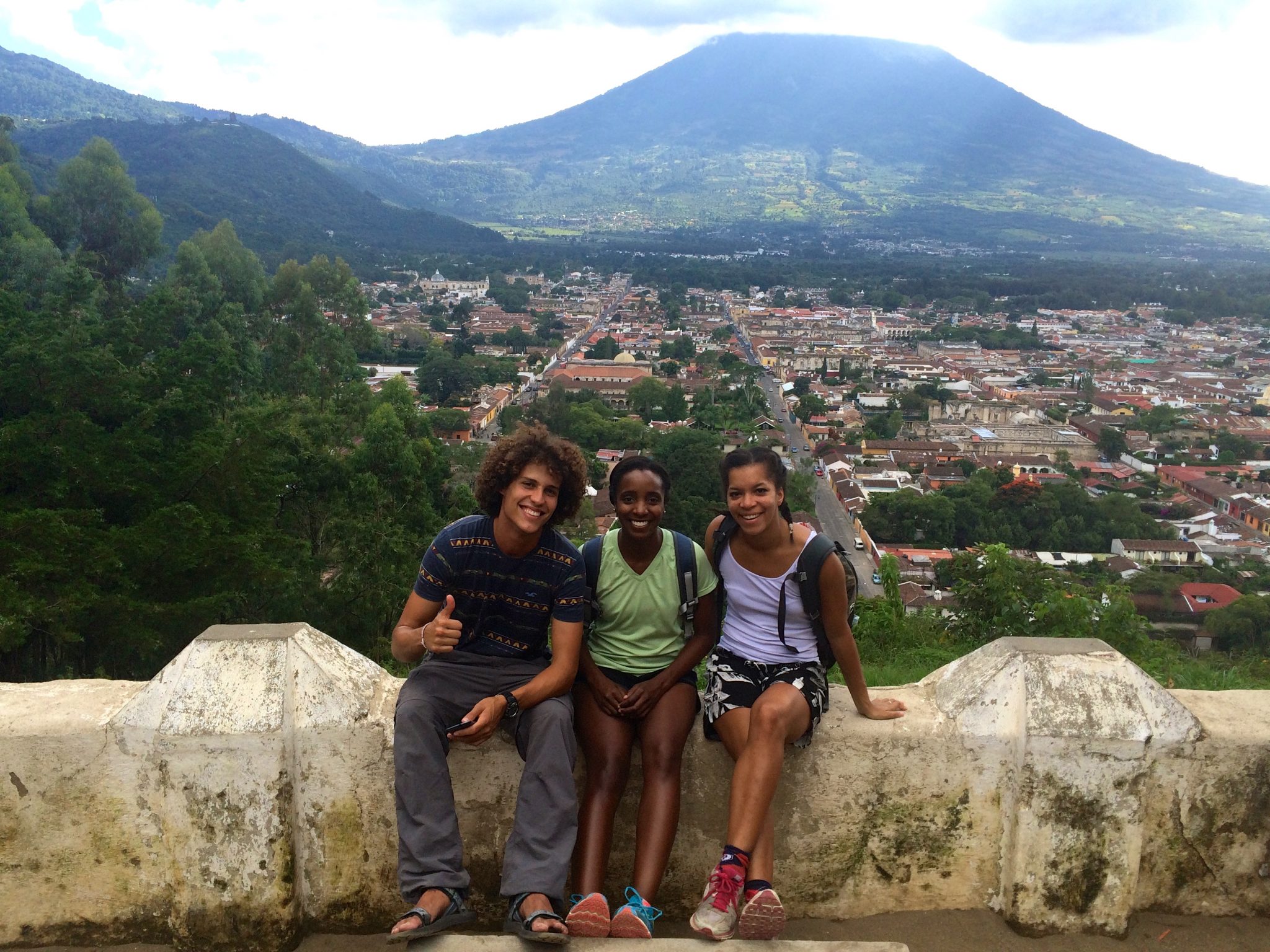
One of the activities was climbing to the top of Cerro de Cruz to get a full view of Antigua and the Volcano

One of the activities was climbing to the top of Cerro de Cruz to get a full view of Antigua and the Volcano

4: 00 – 6:00 PM: Go to a cafe with other students and study.

IMG_4258

My friend Rachel, Damon, and I all studying at one of the many cafes in Antigua. We could stay for hours with the free & fast wifi, array of hot chocolates & teas, small snacks.

7:00 PM: Eat dinner with homestay. 

A typical dinner we would eat. I love me some plantains! At dinner we would discuss plans for the night. We would also share laughs over funny stories and sharing random facts

This shows a typical dinner we would eat. I love me some plantains! At dinner we would discuss plans for the night. We would also share laughs over funny stories and random facts. I now know that there is a female viagra.

9:00 PM – Go to a hostel bar and drink a couple beers. Each beer is $1.33

10:00 PM – 1:00 AM: If it is a Monday then it is quizzo night at an Irish bar. Wednesday and Thursday are ladies night, which means free drinks! Friday and Saturday nights are the busiest since people from Guatemala City come to Antigua. The clubs shut down at 1 am, which is perfect because I’m usually tired from all my studying!

Monday Night Quizzo

Monday Night Quizzo – The bad news- my team got 2nd place. The good news – everyone got free beer at the end!

Sunday is the only day that the homestay does not provide food. Luckily, there’s a great restaurant scene in Antigua, Guatemala, so Sundays are the perfect day to try them.

What is next?

Antigua has been such a pleasure. I definitely see myself coming back in the future and studying Spanish for a couple months. Guatemala, you have stolen my heart! I’m off to Semuc Champey next to visit some natural pools in a jungle 😀

My view every night from my homestay

My view every night from my homestay


Pin It on Pinterest